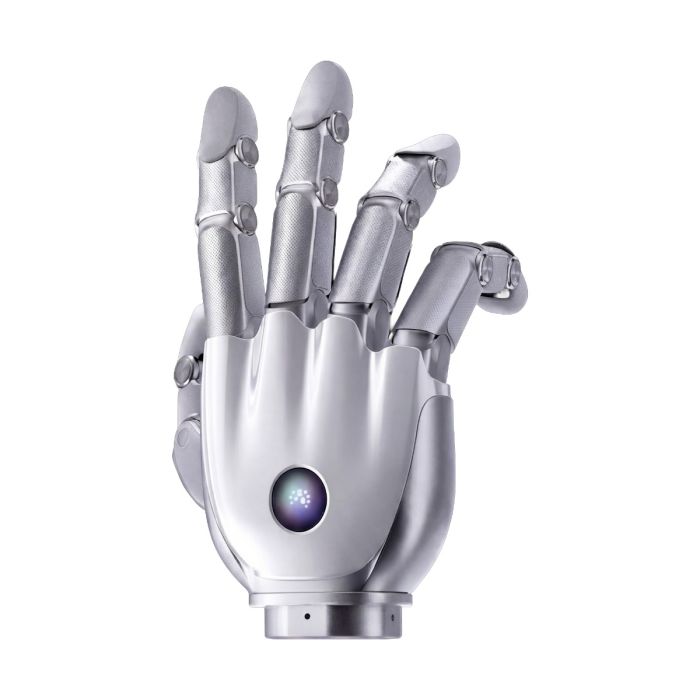
BrainCo Revo 3-21 Basic Robot Hand
In stock
- BRAND:
- BRAINCO
- MODEL:
- REVO 3-21 BASIC
- ORIGIN:
- China
- Warranty:
- 12 MONTHS
- AVAILABILITY:
- SUBJECT TO AVAILABILITY
- SKU:
- BrainCo-Revo-3
BrainCo Revo 3-21 Basic Robot Hand
Robot arms have grown steadily more capable, yet most of them still end their reach in a pair of jaws. The BrainCo Revo 3-21 Basic Robot Hand addresses that final stretch, the part of the machine that actually meets the object. It gives every finger joint group its own motor, so a team can ask for a pinch, a wrap or a gentle release instead of a single open-and-close command.
Robots Latin America sells this hand and supplies it to laboratories, integrators and industrial buyers across Latin America. We prepare the quotation, arrange delivery and customs with it, and stand behind the product with support once it reaches your facility.
Background
BrainCo and the Revo lineage
BrainCo is a Hangzhou-based company that, according to its published materials, was founded in 2015 and already offers three robotic products. The Revo name belongs to its line of dexterous hands, and the third generation, Revo 3, was reported as launched on 10 April 2026. Earlier generations remain in circulation, and our catalog still lists the Revo 1 and Revo 2 hands for buyers who need a simpler device.
The sources name several Revo 3 versions: U21, U21F, U21T and U21VT. Resellers use the labels Basic, Touch and Vision for them. The manufacturer has not published a page for the Basic name, so the mapping between the reseller label and a specific model code should be confirmed with us when you request a quotation.
Positioning and key technology
The Revo 3 is described as a biomimetic dexterous hand designed for industrial automation, scientific research and advanced robotics manipulation. That is a deliberately broad statement, and it matches how the hand is used in practice: it is a development platform as much as a finished tool.
Two design choices stand out in the published description. First, the hand has 21 independently driven motors for 21 fully active degrees of freedom, delivering multi-finger coordination in a compact, lightweight form factor. Second, its joints are direct-driven and backdrivable, which the source credits with rapid response and high control density across all finger segments. In plain terms, the fingers can be commanded precisely, and they can also yield when something pushes back on them.
Where the sources describe the Revo 3 as a whole rather than one version, we treat the statement as applying to every Revo 3 model. Everything below is reported on that basis and comes from a single published source.
Technical Specifications
| Specification | Value |
|---|---|
| Degrees of freedom | 21 fully active, independently driven (reported) |
| Motors | 21 independently driven motors (reported) |
| DoF distribution | Five in the thumb; four in each of the index, middle, ring and pinky fingers (reported) |
| Joint drive | Direct-driven and backdrivable (reported) |
| Durability rating | Over 1,000,000 joint flex cycles (reported) |
| Qualification testing | Vibration, impact, payload, temperature extremes and salt spray (reported) |
| Software | C/C++ and Python SDKs for Linux and Windows (reported) |
| Recommended power supply | Stable 24V DC, rated at least 100W (reported) |
| Default RS485 IDs | Left hand 126, right hand 127, broadcast 0 (reported) |
| Power-on behavior | Physical position calibration; all fingers open during the process (reported) |
| Weight | Not published by the manufacturer |
| Operating temperature | Not published by the manufacturer |
| IP rating | Not published by the manufacturer |
| Operating noise | Not published by the manufacturer |
| Contents of the box | Not published by the manufacturer |
Specifications are as published by a single source and are confirmed against the datasheet at quotation; the manufacturer has not published the weight, temperature range, IP rating, noise level or box contents, and we confirm them when we quote.
What makes the Revo 3 different from a conventional gripper?
A conventional gripper has one or two degrees of freedom. It can close on an object, and that is nearly all it can do. The Revo 3 is reported to have 21, divided in the way a human hand divides them: five in the thumb and four in each of the other four fingers. That layout is what allows a controller to shape the hand around an object, rather than forcing the object into a fixed jaw geometry.
The drive design matters as much as the count. Because the joints are described as direct-driven and backdrivable, an external force on a finger can be felt and followed rather than resisted. For work near people, for teaching by demonstration, or for contact with delicate parts, that behavior is often more valuable than raw holding force. We would add one caution: the manufacturer has not published payload or grip force for this hand, so any application that depends on a specific load should be confirmed at quotation.
The durability claim is also worth reading carefully. The hand is rated for over 1,000,000 joint flex cycles and, per the source, qualified through vibration, impact, payload, temperature extremes and salt spray testing. This points to a device meant for repeated work rather than a single demonstration, though the test conditions themselves are not detailed in the sources we hold.
How is the Revo 3 integrated and powered?
Integration is an area where the published information is relatively concrete. The hand communicates over an RS485 bus. By default, a left hand answers at ID 126, a right hand at ID 127, and a broadcast command at ID 0 reaches every hand on the network. Software support is described as cross-platform, with C/C++ and Python SDKs compatible with Linux and Windows, which covers the toolchains most research groups and automation teams already use.
For power, the source recommends a stable 24V DC supply rated at no less than 100W, chosen to reduce the risk of voltage drop. Plan for this when designing a cell, because a marginal supply is a common source of intermittent faults in multi-motor devices.
On each power-up, the hand carries out a physical position calibration. It searches for the starting position of each finger, and all fingers open while it does so. Keep the fingers clear of obstructions, and design your start-up sequence so that nothing sits in the hand's path when power is applied.
Who is the BrainCo Revo 3-21 Basic Robot Hand for?
Research laboratories are the clearest fit. Groups working on manipulation, imitation learning or tactile control need a hand where each joint can be commanded and studied, and the SDK support lowers the cost of getting started.
Industrial automation teams form the second segment, particularly those handling parts of varied shape that a custom gripper would need to be redesigned for. System integrators will value the RS485 addressing and the ability to run several hands on one bus.
A third segment is organizations building service, assistive or healthcare robots, where a hand needs to behave gently around people. Our Medical Robots category brings together related equipment for those projects.
The sources also name Touch and Vision versions of the Revo 3, and the fact sheet does not detail how they differ from the Basic hand beyond the labels. If your work depends on sensing contact or on added perception, review the BrainCo Revo 3-21 Touch Robot Hand and the BrainCo Revo 3-21 V-Touch Robot Hand, and ask us to confirm the differences at quotation. Buyers who want to compare across the whole family can browse the BrainCo Revo 3 category. Teams whose tasks are simpler may also consider the earlier BrainCo Revo 1 Intelligent Dexterous Bionic Hand.
What is the BrainCo Revo 3-21 Basic Robot Hand used for?
- Dexterous manipulation research. Independent control of 21 joints supports studies of grasping, in-hand motion and coordinated finger movement.
- Industrial automation. The manufacturer names automation as an intended use, for tasks that exceed what a simple gripper handles.
- Robot learning and teleoperation. Backdrivable joints and SDK access suit teams that teach or guide the hand and record its behavior.
- Advanced humanoid and arm-mounted platforms. A compact, lightweight hand, as the source describes it, is a natural end effector for general-purpose robots.
- Service and assistive robotics. Compliant joints are useful where a robot must interact with people and everyday objects.
- Education and technical demonstration. A human-like hand gives students and visitors a tangible view of modern manipulation engineering.
Pricing and Availability
We do not publish prices for this hand. Robots Latin America prepares each quotation against your configuration, quantity and destination, so please send us your application details to begin. Delivery, customs and support are arranged together with the quotation, which means you receive one coordinated answer instead of separate offers. The way to obtain current terms for the BrainCo Revo 3-21 Basic Robot Hand is the quotation request available on this page.
Frequently Asked Questions
How many degrees of freedom does the Revo 3 have?
The source reports 21 fully active degrees of freedom, each with its own motor. Five are in the thumb and four in each of the other fingers.
Which operating systems does the SDK support?
The published SDKs are in C/C++ and Python and are reported as compatible with Linux and Windows.
What power supply does the hand need?
The source recommends a stable 24V DC supply with a rating of at least 100W, to reduce the risk of voltage drop.
What are the default RS485 IDs?
Per the published documentation, the default left hand ID is 126, the right hand ID is 127, and the broadcast ID is 0.
Why do the fingers open when the hand is switched on?
The hand performs a physical position calibration at power-on, searching for the starting position of each finger. All fingers open during that period.
What is the weight, IP rating or payload?
The manufacturer has not published the weight, IP rating, operating temperature, noise level or payload figure. We confirm these values at quotation.
Where can I buy the BrainCo Revo 3-21 Basic Robot Hand and what does it cost?
Robots Latin America supplies it across Latin America. We do not list prices, so please request a quotation and we will respond with terms for your project.
Summary
Most robot arms stop at a pair of jaws; the BrainCo Revo 3-21 Basic Robot Hand is intended to continue the arm with something much closer to a hand, with 21 driven degrees of freedom, backdrivable joints, a durability rating above 1,000,000 flex cycles and SDK support for Linux and Windows, all as reported by a single published source. Several practical figures remain unpublished and are confirmed at quotation. For buyers in Latin America who want to evaluate it, with delivery, customs and support handled by Robots Latin America, this page is the starting point.