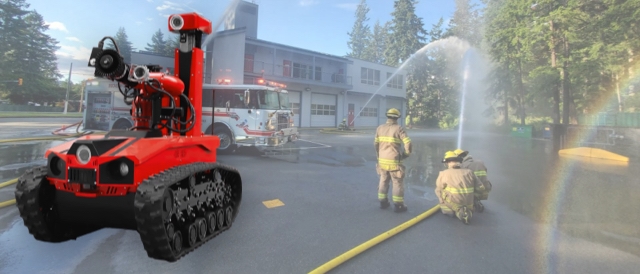
Research Robots for automation, research, security, logistics, education and industrial projects across Latin America, with a practical focus on applications, integration and quote-based procurement.

Research Robots

  • Unitree G1
  • Unitree G1
  • Unitree G1
  • Unitree G1
  • Unitree G1
    Special Price US$69,500.00 US$73,900.00
  • Unitree G1
  • Unitree G1
  • Unitree G1
  • Unitree G1
  • Unitree Robotics R1 Edu Standard (R1 EDU U1)
    US$15,950.00
  • Unitree Robotics R1 Edu Smart (R1 EDU U2)
    US$18,900.00
  • Unitree Robotics R1 Edu Pro A (R1 EDU U3)
    US$30,900.00
  • Unitree Robotics R1 Edu Pro B Humanoid Robot (R1 EDU U4)
    US$31,260.00
  • Unitree Robotics R1 Edu Pro C Humanoid Robot (R1 EDU U5)
  • Unitree Robotics R1 Edu Pro D Humanoid Robot (R1 EDU U6)
    US$31,260.00

Research Robots for Latin America

This page provides practical information about Research Robots for buyers, integrators, universities, distributors and technical teams across Latin America. The focus is the product: what it does, where it is used, which specifications matter and how to evaluate it for real deployments.

Main applications

Research Robots can support manufacturing, mining, energy, agriculture, education, healthcare, security, retail, hospitality, research and logistics projects. The right choice depends on operating environment, task type, autonomy, payload, mobility, sensors, software, maintenance access and integration requirements.

Technical selection criteria

Before requesting a quote, compare payload, battery life, speed, environmental rating, precision, connectivity, ROS or SDK compatibility, camera and LiDAR options, arms, hands, charging stations, spare parts and documentation. Industrial projects also require operator training, system integration planning and after-sales support.

Regional procurement and deployment

Latin America projects often require planning for import, lead time, warranty, interface language, technical documentation, training and accessory availability. A strong procurement process defines the use case, site conditions, budget, safety requirements and success metrics before selecting a model.

FAQ

How should a model be selected? Start with the task, environment and autonomy level. Can it be used for research? Many models fit labs and universities when they include SDKs, documentation and configurable sensors. Does purchase require a quote? Advanced robotics is commonly quoted by configuration, accessories, logistics and support needs.

Summary

Research Robots can modernize operations in Latin America when evaluated by application, specification, integration plan and total project cost rather than appearance or brand alone.

Questions

Your Question:

Research Robots: Advancing Science and Innovation with AI-Powered Robotics

Research robots are transforming the way scientists, engineers, and innovators conduct experiments, collect data, and develop cutting-edge technologies. By combining artificial intelligence, automation, and precise robotics engineering, these robots provide unparalleled capabilities for research institutions, universities, laboratories, and innovation centers. Designed for versatility, accuracy, and adaptability, research robots are crucial tools for accelerating discovery and pushing the boundaries of knowledge in fields such as AI, robotics, engineering, and applied sciences.


What Are Research Robots?

Research robots are specially designed robotic systems used to support experiments, testing, and innovation. They can range from humanoid robots for human-robot interaction studies to quadruped robots for mobility and terrain research. Equipped with sensors, AI algorithms, and automation software, research robots can:

  • Perform repetitive or precise laboratory tasks with accuracy

  • Collect and analyze data efficiently

  • Simulate real-world scenarios for experimentation

  • Interact with humans for behavioral and robotics studies

  • Adapt autonomously to changing experimental conditions

These capabilities make research robots indispensable for institutions that aim to enhance productivity, reliability, and scientific innovation.


Applications of Research Robots

1. Academic Research

Universities and technical institutions use research robots to teach robotics, artificial intelligence, and engineering concepts. Students can program and experiment with robots to understand robotics mechanics, AI behavior, and data-driven decision-making, making learning interactive and practical.

2. Laboratory Automation

Research robots streamline laboratory work by automating repetitive or high-precision tasks, such as pipetting, sample handling, and environmental monitoring. This not only reduces human error but also speeds up experimentation and increases reproducibility of results.

3. Robotics and AI Development

Research robots provide an ideal platform for testing AI algorithms, robotic motion planning, and machine learning models. Engineers can experiment in controlled environments before deploying robots in real-world applications, advancing innovation in industrial, service, and exploration robotics.

4. Healthcare and Biomedical Research

Robots are increasingly used in biomedical research for assisting in surgeries, patient monitoring, and lab experiments. With precise motion control and data collection capabilities, research robots enhance the accuracy of experiments and accelerate medical innovation.

5. Exploration and Environmental Research

Quadruped or mobile research robots allow scientists to study difficult terrains, underwater environments, and hazardous areas safely. These robots gather critical environmental data, helping researchers make informed decisions while reducing risks to human personnel.


Why Choose Research Robots?

Investing in research robots offers numerous advantages:

  • Precision and Accuracy: Conduct experiments with minimal error

  • Efficiency and Automation: Save time on repetitive or labor-intensive tasks

  • Versatility: Suitable for laboratories, universities, and field research

  • AI Integration: Test and implement advanced algorithms for robotics and automation

  • Innovation: Empower scientists, engineers, and institutions to stay at the forefront of technological advancement

By integrating research robots into labs and institutions, organizations can achieve higher productivity, better data accuracy, and accelerated innovation across multiple scientific and engineering fields.


Buying Research Robots

Acquiring research robots requires careful consideration of factors such as mobility, AI capabilities, programming interfaces, and adaptability to research needs. Leading suppliers offer humanoid, quadruped, and specialized research robots tailored for specific laboratory, academic, or industrial applications. Choosing the right research robot ensures maximum ROI, efficiency, and scalability for your innovation projects.


Conclusion: The Future of Research Robots

Research robots are not just tools—they are intelligent partners in scientific discovery and technological advancement. From education and laboratory automation to AI development and environmental exploration, research robots provide versatile, reliable, and advanced solutions for modern research. By investing in AI-powered research robots, institutions and innovators can accelerate experimentation, enhance accuracy, and drive breakthroughs in robotics and applied sciences.