BrainCo Revo 1 Intelligent Dexterous Bionic Hand
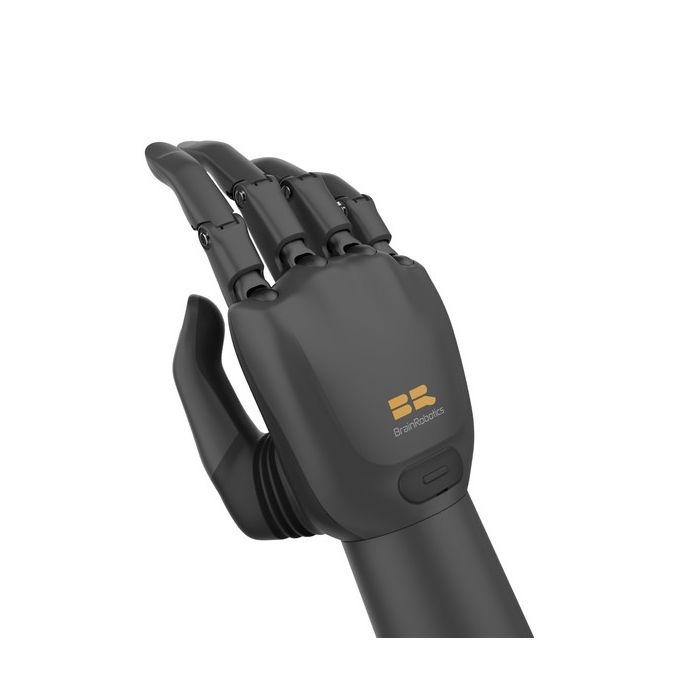
The BrainCo Revo 1 Intelligent Dexterous Bionic Hand is a robotic dexterous hand platform from BrainCo, a brain-computer-interface and human-machine-interface company that publicly lists “BrainCo Bionic Dexterous Hand Revo1” among its product lines on its official website. BrainCo positions itself as a company working across bionic hands, bionic knees, neurotechnology, and AI-oriented robotics solutions.
In stock
- BRAND:
- BRAINCO
- PART #:
- Intelligent Dexterous Bionic Hand
- ORIGIN:
- China
- Warranty:
- 12 MONTHS
- AVAILABILITY:
- SUBJECT TO AVAILABILITY
- SKU:
- BrainCo-Dexterous-Bionic-Hand
BrainCo Revo 1 Intelligent Dexterous Bionic Hand
Between a decision made in software and an object held in a hand, there is a long chain of small mechanical choices. The BrainCo Revo 1 Intelligent Dexterous Bionic Hand is an attempt to make that chain shorter: a hand from a company that works on brain-computer interfaces, offered to teams who need fingers that can follow instructions with some subtlety. Its published description is a biomimetic dexterous hand with 6 active joints and 10 degrees of freedom, a figure reported in a single published source.
Robots Latin America supplies the BrainCo Revo 1 to customers across Latin America. We prepare the quotation, arrange delivery and customs, and provide support for the project, so that your team deals with one seller from the first technical question to commissioning.
Background
BrainCo and its lineage
BrainCo was founded in 2015 and incubated by the Harvard Innovation Lab, according to the company's published profile. It is based in Somerville, Massachusetts, and has focused on developing a non-invasive brain-computer interface. That history explains the character of the hand. The company is not a traditional maker of industrial grippers. It comes from the world of human-machine interfaces, where the question is how a person's intent reaches a machine.
This is also why the software side of the Revo 1 deserves attention. The published materials list a ROS 2 driver covering Revo 2 and Revo 1 hand control, together with Python and C/C++ SDK examples for Revo 2 and Revo 1, the Control Glove and the EMG Armband. These are reported from a single source, so integration teams should confirm the current versions of the packages when they request a quotation.
Positioning and key technology
The Revo 1 is a biomimetic hand. Instead of two opposing jaws, it arranges a thumb and four fingers after the human pattern. The thumb has two active degrees of freedom, abduction/adduction and flexion/extension. Each of the other four fingers has one active and one passive flexion/extension degree of freedom. Together this gives the 6 active joints and 10 degrees of freedom reported in the specification.
Two software behaviours are described in the published documentation. The first is automatic calibration: after power-on, the hand runs a position calibration sweep by itself. The second is Turbo mode, which is based on stall detection. When a finger stalls against an object, it pauses for the configured stall duration and then continues gripping at 500 ms intervals. Both are reported per the published specification.
Technical Specifications
| Specification | Value |
|---|---|
| Type | Biomimetic dexterous hand |
| Active joints | 6 |
| Degrees of freedom | 10 |
| Thumb | 2 active degrees of freedom (abduction/adduction, flexion/extension) |
| Other four fingers | Each 1 active and 1 passive flexion/extension degree of freedom |
| Maximum hand load | 30 kg |
| Five-finger grip force | 50 N |
| Control modes | Position and Speed |
| Turbo mode | Stall detection; after the configured stall duration, gripping continues at 500 ms intervals |
| Power-on behavior | Automatic position calibration sweep |
| Default device ID | 1, configurable within 1 - 254 |
| Interface | Under the wrist; connector model PAP-05V-S |
| LED | Colors and patterns configurable by the user |
| Hardware variants | Revo 1 Basic and Revo 1 Advanced; tactile sensing depends on the SKU |
| Weight, dimensions, IP rating, certifications, box contents | Not published by the manufacturer; confirmed at quotation |
Specifications as published in a single source; they are confirmed against the datasheet at quotation.
What do the Basic and Advanced variants change?
The sources name two public hardware variants, Revo 1 Basic and Revo 1 Advanced, and they also mention a Basic Touch SKU. The only distinction they state is that tactile sensing depends on the SKU. They do not publish separate figures for each variant, so we do not assign the load, grip force or joint figures above to one version rather than another. Which variant carries which sensing, and what each includes, is confirmed when the quotation is prepared.
For a buyer, this matters in a practical way. If your project depends on detecting contact, for example to decide when an object is secure, state that requirement at the outset so that the correct SKU is quoted. If the work is mainly about motion and positioning, a variant without tactile sensing may be sufficient. Either way, the choice should be made against the datasheet and not from assumptions.
How does the Revo 1 behave when it grips an object?
The published control modes are Position and Speed. In practice, a developer can ask a finger to reach a target position or can drive it at a chosen speed. Turbo mode adds a response to resistance. Once a finger stalls against an object, it waits for the configured stall duration and then keeps gripping at 500 ms intervals, which is reported as the way the hand persists in holding an item.
The reported mechanical limits are a maximum hand load of 30 kg and a five-finger grip force of 50 N. Both figures come from a single source, and the manufacturer has not published the test conditions behind them in the material we hold. Confirm how the load is measured, and for what type of grasp, before designing around it.
Other practical details come from the same documentation. The default device ID is 1 and can be changed within 1 - 254, which matters when several hands share a communication line. The interface sits under the wrist with connector model PAP-05V-S, and the LED colors and patterns can be customized by the user. Details such as hand weight, dimensions, ingress protection and certifications are not published, so mounting, enclosure and compliance planning should wait for the datasheet.
Who is the BrainCo Revo 1 for?
Research laboratories and universities are the most natural audience. The ROS 2 driver and the SDK examples give teams a way to begin experiments without writing every layer themselves, and the Control Glove and EMG Armband examples point toward teleoperation and human-machine interaction studies.
Robotics integrators building prototypes for manipulation, demonstrations or pilot cells will find a hand with a documented joint layout and defined control modes. Teams working on assistive and rehabilitation concepts may also look at it, and our Medical Robots category shows related equipment. Educators who want students to work with a real anthropomorphic hand are another group.
Buyers who want to compare it with other BrainCo hands can browse the BrainCo Revo 1 category, or look at the newer BrainCo Revo 2 Basic Right Dexterous Bionic Hand (XRR). We do not claim figures for that model here; ask us for its separate specifications.
What is the BrainCo Revo 1 used for?
- Robotics research. Testing grasping strategies on a hand with a thumb that moves in two directions and four fingers with one driven and one passive joint.
- Teleoperation studies. Pairing the hand with the Control Glove or EMG Armband, for which SDK examples are listed.
- ROS 2 prototyping. Using the published ROS 2 driver to bring the hand into an existing software stack.
- Assistive and medical concepts. Exploring human-machine interaction for bionic and rehabilitation applications.
- Teaching. Giving students a working anthropomorphic hand for control and mechatronics courses.
- Demonstrations. Showing biomimetic manipulation at laboratories, trade events and technical presentations.
Pricing and Availability
We do not publish prices on this page. To receive a quotation, tell Robots Latin America which variant you need, whether tactile sensing is required, and the country of delivery. Delivery, customs and support are arranged with the quotation, so that you see the complete scope before you commit. Current availability and the way to request a quotation are available on this page.
Frequently Asked Questions
How many joints and degrees of freedom does the Revo 1 have?
It is reported to have 6 active joints and 10 degrees of freedom. The thumb has two active degrees of freedom, and each of the other four fingers has one active and one passive flexion/extension degree of freedom.
What load and grip force are published?
The published maximum hand load is 30 kg, and the five-finger grip force is 50 N. Both come from a single source and are confirmed against the datasheet at quotation.
Which control software is available?
The sources list a ROS 2 driver and Python and C/C++ SDK examples, including examples for the Control Glove and EMG Armband. Confirm versions at quotation.
What is Turbo mode?
Turbo mode is based on stall detection. When a finger stalls against an object, it pauses for the configured stall duration and then continues gripping at 500 ms intervals.
Does the Revo 1 include tactile sensing?
It depends on the SKU. The public variants are Revo 1 Basic and Revo 1 Advanced, and a Basic Touch SKU is also named. We confirm what each includes when we quote.
Are the weight, dimensions and IP rating available?
The manufacturer has not published the hand weight, dimensions, IP rating, certifications or box contents. These are confirmed at quotation.
Where can I buy the BrainCo Revo 1 and what does it cost?
You can buy it from Robots Latin America, which supplies it across Latin America. The cost depends on the variant and the destination, so request a quotation and we will respond with the complete scope.
Summary
The question behind the BrainCo Revo 1 is how a command in software becomes a grasp that adapts. Its answer is a biomimetic hand with 6 active joints, 10 degrees of freedom, Position and Speed control, stall-based Turbo mode, and a software ecosystem built around ROS 2 and SDK examples. Several details, from weight to certifications, are still unpublished and will be confirmed with the quotation. For teams in Latin America ready to evaluate it, this page is the starting point.