AgiBot A2-W Flexible Manufacturing Wheeled Humanoid Robot
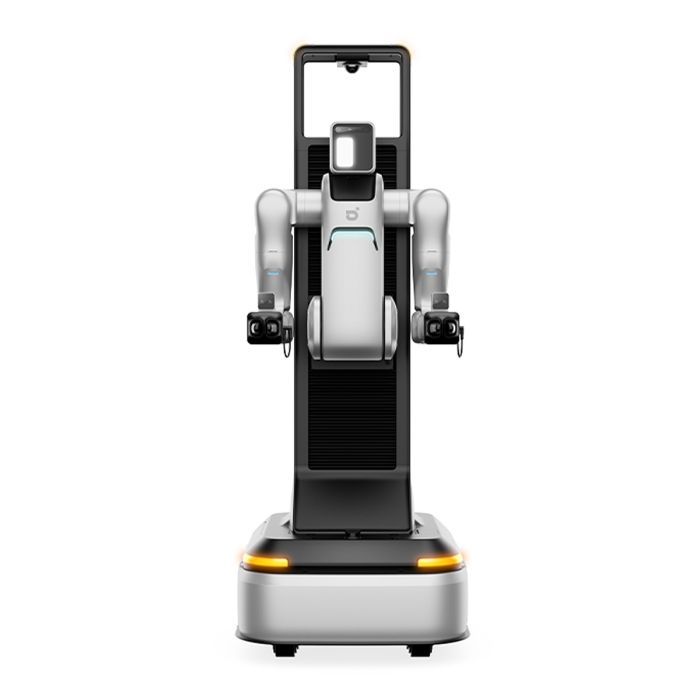
The AgiBot A2-W is a wheeled general-purpose humanoid robot developed by AgiBot (Zhiyuan Robotics; Chinese: 智元机器人), a Shanghai-based robotics company founded in February 2023. The A2-W is the industrial manufacturing variant within AgiBot's Yuanzheng A2 product family, distinguished from its bipedal siblings by its four-wheel-drive mobile base, extended five-hour battery runtime, and specialized optimization for factory floor tasks including loading and unloading, terminal plugging, vibratory feeder loading, logistics transportation, pallet transport, and quality inspection handling.
In stock
- BRAND:
- AGIBOT
- PART #:
- A2-W
- ORIGIN:
- China
- AVAILABILITY:
- USUALLY SHIPS IN 7-14 BUSINESS DAYS
- SKU:
- AgiBot-A2-W
AgiBot A2-W Flexible Manufacturing Wheeled Humanoid Robot for Latin America projects
AgiBot A2-W Flexible Manufacturing Wheeled Humanoid Robot is an advanced robotics option for organizations evaluating A2 Series, Wheeled Humanoids, AgiBot across Latin America. Selection should focus on task fit, operating environment, integration, safety, training and total project cost.
Typical applications
This product may be considered for automation, research, technical demonstrations, inspection, logistics, education, commercial service or industrial operations depending on configuration. Before purchase, define the workflow, operating space, human interaction model, required accessories and performance metrics.
Technical evaluation
Review autonomy, payload, mobility, sensors, cameras, connectivity, software compatibility, programming options, documentation, spare parts and maintenance requirements. Professional deployments should also validate interface language, user training, operational safety and integration support.
Product details to review
AgiBot A2-W Flexible Manufacturing Wheeled Humanoid Robot: Complete Guide AgiBot officially describes the A2-W as a "Flexible Manufacturing Robot" a designation that captures its core value proposition: a mobile, dexterous manipulation platform that can be redeployed across multiple workstations and task types within a production facility without the extensive retooling and reprogramming required by conventional fixed industrial robots.
Regional procurement and logistics
For buyers in Mexico, Central America, South America and the Caribbean, quoting should consider configuration, accessories, packaging, lead time, importation, warranty, training and technical support. Reference SKU: AgiBot-A2-W.
FAQ
Is it suitable for professional use? Suitability depends on configuration and operating environment. Can it integrate with existing systems? Review SDKs, APIs, documentation and compatibility before purchase. Should it be quoted? Yes, especially when accessories, spare parts, training or international logistics are required.
Summary
AgiBot A2-W Flexible Manufacturing Wheeled Humanoid Robot should be evaluated as part of a complete Latin America solution: product, application, support, logistics and technical integration.
Specifications
General
Physical
Mobility
Performance
Computing
Battery + Power
Feature
-
Modular design of atomic capabilities allows for OTA iterative upgrades; the task skill library can be continuously expanded, becoming richer with use.
-
Embodied algorithms can be continuously optimized through data collection and training, becoming smarter and more efficient over time.
-
Integrated design for data collection, simulation training, and inference deployment supports efficient data acquisition and deployment.
-
360° Lidar, 4 AI vision sensors, and 2 six-dimensional force sensors combine to provide multi-sensor fusion perception, enabling millisecond-level detection and intelligent obstacle avoidance.
-
The arm collision detection system, 360° real-time environmental sensing, and redundant perception and control design ensure safety for both personnel and the environment.
- Supports hot-swappable batteries with energy replenishment in minutes and autonomous charging, reducing manual intervention.
- Built-in real-time task self-diagnosis and self-recovery mechanisms minimize unplanned downtime and maintenance efforts.