
RoboParty ROBOTO Origin
In stock
- MARCA:
- RoboParty
- MODELO:
- ROBOTO Origin
- ORIGIN:
- China
- Warranty:
- 12 MONTHS
- AVAILABILITY:
- SUBJECT TO AVAILABILITY
- SKU:
- RoboParty-ROBOTO-Origin
RoboParty ROBOTO Origin
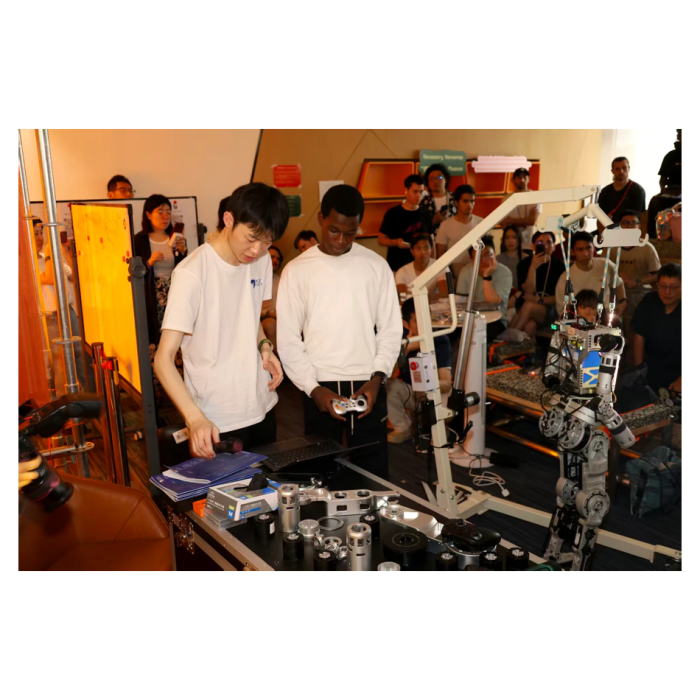
RoboParty ROBOTO Origin is an open-source humanoid robot intended for developers who want to understand and work with the design from the component level upward. The manufacturer presents it as a hands-on platform rather than simply a finished motion demonstration. Its published specification describes a 1.25 m robot with 23 degrees of freedom, a 48 V battery system and ROS 2 development support.
Mechanical Layout
ROBOTO Origin has a listed physical mass of 34 kg. The source gives a thigh length of 250 mm, calf length of 300 mm and total single-arm length of 440 mm. It does not provide a complete shipping envelope or packaged mass. These figures should therefore be used for understanding the robot’s structure, not for estimating freight charges or determining all of the space required for dynamic operation.
Each arm has five degrees of freedom: three at the shoulder, one at the elbow and one at the wrist. Each leg has six: three at the hip, one at the knee and two at the ankle. One additional degree of freedom is provided at the waist. This arrangement accounts for the listed 23 total degrees of freedom without requiring an assumed powered head or an unspecified hand configuration.
Joints and Motion
The design uses parallel ankles and human-like offset joints. RoboParty also identifies CNC precision machining and a separation between the structural body and exterior elements. These are useful descriptions of the mechanical approach, but the page does not provide a load-case analysis, joint-bearing lifetime or structural certification. Detailed mechanical design work should refer to the released drawings and actual hardware revision.
The manufacturer lists movement speed at 3 m/s, arm-joint peak torque at 27 N·m and leg-joint peak torque at 120 N·m. Peak torque should not be interpreted as continuously available torque, and a joint-torque value is not a hand payload specification. The page does not establish a rated carrying capacity, stair-climbing height or slope rating for ROBOTO Origin, so those fields are intentionally left open.
Power and Runtime
The battery specification is 48 V and 15 Ah. Stated runtime is more than two hours, with an explicit manufacturer warning that endurance depends on load, configuration and operating conditions. A motion-heavy trial, an altered hardware setup and another test procedure should not be assumed to produce the same runtime. The published figure is best used as a manufacturer reference when planning a more specific evaluation.
The source does not establish charging time, charger power, battery hot-swap capability or a guaranteed number of battery cycles. Those details need confirmation for a laboratory scheduling or procurement decision. In particular, RP1 battery features should not be copied into an Origin listing simply because both products are RoboParty humanoids.
Optional Perception Equipment
Intel D435i depth sensing and 3D LiDAR are identified as optional accessories. Their appearance in the product specification does not mean they are included in a standard delivery. A quotation should name the selected sensors and clarify their mounting, wiring and software configuration. Projects needing depth perception should verify the whole sensor arrangement rather than treating an optional component name as proof of an operational perception stack.
Connectivity and Development Resources
ROS 2 is the listed software framework. Wireless connectivity includes Wi-Fi 6 and Bluetooth 5.2, and the platform supports OTA updates. The control-interface description includes a low-level control SDK and manual control. These provisions are relevant to developers working on robot control and software integration, although they do not establish that a particular application or learning policy is supplied ready to use.
The open resources cover mechanical structures, circuit designs, control algorithms and simulation materials. Together they support examining how physical design, electronics and control interact. Before adopting the platform, a project team should check the relevant repository revision, build information and dependencies against the hardware being quoted. Open access is a development advantage, not a substitute for commissioning, testing or safe experimental practice.
Research Use and Ordering
ROBOTO Origin is relevant to hands-on humanoid development, control experiments and work connecting simulation with physical hardware. These are application contexts consistent with the manufacturer’s open-platform positioning, not claims of validated performance for a particular industrial process. The published page does not establish certification for collaborative work, unrestricted public operation or unattended deployment.
A configuration enquiry should distinguish this model from the later RP1 variants and identify the required sensors, supplied development resources and battery equipment. No selling price, warranty term, stock status or delivery date is asserted here. Physical mass should remain a technical product attribute, separate from any later catalog shipping-weight decision.
Frequently Asked Questions
What is ROBOTO Origin?
It is RoboParty’s open-source humanoid platform with 23 degrees of freedom and published mechanical, electronic, control and simulation resources.
How does ROBOTO Origin support development?
The robot combines articulated hardware with ROS 2, a low-level control SDK, manual control and open design material for component-level investigation.
Are its depth camera and LiDAR standard?
No. The manufacturer marks the Intel D435i depth camera and 3D LiDAR as optional accessories; their inclusion must be confirmed.
What are the benefits for research?
Documented hardware and software access can help teams investigate the relationship between mechanical design, control and simulation without treating the platform as an entirely closed system.
Where can I buy ROBOTO Origin?
Start with RoboParty’s official ROBOTO Origin page and request a current configuration and quotation. Confirm included equipment and commercial terms before ordering.
Summary
ROBOTO Origin is a compact open-development humanoid with a clearly documented articulation layout and optional perception equipment. Its suitability depends on the actual configuration and the needs of the proposed research programme, not on specifications borrowed from another RoboParty model.